
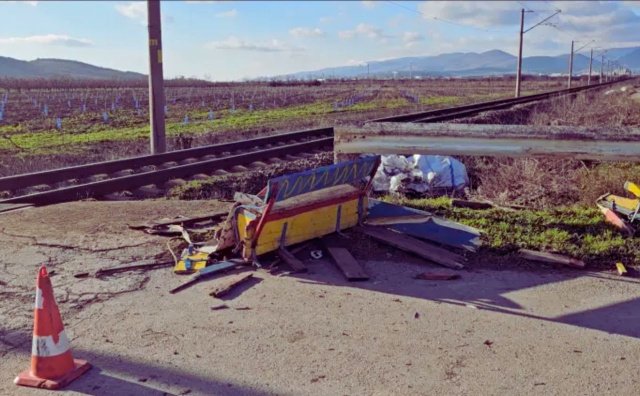
A tragic railway accident near the Bulgarian city of Sliven claimed the lives of a 35-year-old woman and her two-year-old child on Tuesday morning, after a Sofia–Burgas passenger train collided with a horse-cart at a level crossing.
The collision occurred at the “Debelata Koriya” railway crossing, an area used frequently by local residents traveling between nearby settlements and fields. Emergency services were dispatched immediately, but the mother and child were pronounced dead at the scene.

According to initial reports, the horse-cart was carrying between five and six people at the time of the accident. Despite the severity of the collision, the remaining passengers on the cart, as well as the horse, escaped without injuries.
Authorities said the train was traveling on its regular route from Sofia to the coastal city of Burgas when it struck the rear section of the cart as it crossed the tracks. Investigators are now working to determine whether visibility, signaling, or human error contributed to the crash.
One working theory suggests that the rear part of the horse-cart, commonly referred to as the “tail,” may have remained on the tracks for too long, making contact with the oncoming train. Officials stressed that this possibility remains under investigation.
Local residents reported that the family involved in the accident had been collecting plastic tubes from a nearby dump site. The materials were reportedly intended for resale, providing food and basic necessities for the family.
The father of the child and husband of the deceased woman, Stefan Ivanov, was among those traveling in the cart at the time. Speaking through tears, he described the moments leading up to the collision and the shock that followed.
“I don’t know how it happened,” Ivanov said. “The train was near the bridge, about 50 meters away, and then the line started to sound. My little daughter and my wife are gone. I’m in shock.”
He added that the aftermath of the impact remains a blur. “Look at my little daughter’s clothes, they were flying from behind. I can’t remember what happened and what didn’t,” he said.
Witnesses in the area reported hearing the train’s horn shortly before the collision, followed by a loud impact. Some rushed toward the crossing to offer help before emergency responders arrived.
Railway officials confirmed that the train driver applied emergency brakes but was unable to stop in time. Passenger trains on the Sofia–Burgas line were temporarily delayed as police secured the scene and investigators conducted preliminary inspections.
The Debelata Koriya crossing has no full barrier system, relying instead on signage and audible warnings. Such crossings are common in rural parts of Bulgaria, where horse-carts remain a regular means of transport for some communities.
Safety advocates have long warned that these crossings pose heightened risks, particularly when slow-moving vehicles attempt to cross active rail lines. Calls for improved infrastructure and better protection measures have intensified following previous fatal incidents.
Police and railway authorities have launched a formal investigation into the circumstances surrounding the crash. This includes reviewing train speed data, warning signals, and whether all traffic regulations were followed at the crossing.
Prosecutors are expected to determine whether negligence played a role, though officials cautioned that conclusions will only be drawn after a full technical and forensic assessment. The tragedy has sparked renewed debate about poverty and safety in rural regions, where families often rely on informal work and outdated transport methods to survive.
As Sliven mourns the loss of a young mother and her child, authorities have urged caution at railway crossings and emphasized the importance of adhering strictly to safety warnings. Further updates are expected once investigators complete their examination and release official findings.