
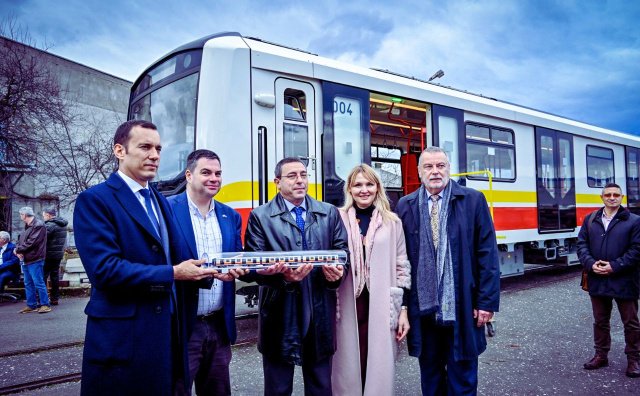
Sofia took a major step toward modernising its urban transport system today with the official presentation of the first new Škoda metro train. The unveiling took place at the Obelya depot, attended by Mayor Vasil Terziev, Škoda representatives and senior officials from Metropolitan EAD.
The new train, manufactured in the Czech Republic, is designed to replace the oldest Russian-built units that have been running since the metro’s early years. The fleet upgrade is part of Sofia’s long-term strategy to expand capacity, improve comfort and future-proof the network.

The model displayed today stretches 80 metres and includes a continuous interior layout, allowing passengers to move freely across all four carriages. It is equipped with redesigned seating, electronic displays and dedicated spaces for wheelchairs, strollers and bicycles.
Accessibility features have been significantly improved. The manufacturer highlighted smoother acceleration and braking systems, while noting the train’s enhanced energy efficiency during operation.
Mayor Terziev described the metro as one of Sofia’s highest priorities. He emphasised that investment in new rolling stock is essential to delivering a modern, sustainable transport system for residents and visitors.
Metropolitan EAD executive director Nikolay Naydenov confirmed that eight new trains will be delivered. Commuters can expect to ride them starting July 2026, following extensive testing and phased commissioning.
Škoda Group representatives stated that the contract for the eight units is worth €66 million, though the overall project totals €68.5 million. They highlighted that the trains will support both increased passenger demand and improved service intervals on key lines.
The new trains will also assist the opening of Sofia’s upcoming station between Slivnitsa and Obelya, where construction began in October. The addition of fresh rolling stock will allow shorter headways, easing congestion during peak hours.
Each train includes rechargeable batteries capable of powering up to one kilometre of autonomous movement in case of technical failure. This feature aims to enhance operational reliability and minimise service disruptions.
Initial testing has already been carried out in the Czech Republic. The second and third trains are scheduled to arrive in Sofia for trials by the end of 2025, with the remaining five to follow.
The final unit in the series should reach Sofia by May 2026, enabling full implementation of the fleet throughout the network. Terziev said the delivery schedule is on track, with teams coordinating closely across all stages.
The upgrade comes as Sofia accelerates construction on ten new metro stations.
Terziev confirmed that the municipality expects to soon select a contractor for the extension of Line 1 along Tsaritsa Ioana Boulevard.
Design work also continues on the Studentski Grad routes, which are considered vital for serving the city’s largest student district. Officials say metro expansion remains a cornerstone of Sofia’s long-term mobility agenda.
Technical specifications presented today underline the trains’ capacity for heavy urban use.
Weighing 116.3 tons and capable of reaching 90 km/h, each unit can accommodate up to 762 passengers.
A next-generation climate control system will ensure comfort throughout the year.
The security system includes video surveillance with data retained for at least twenty days, strengthening passenger safety.
According to both Škoda Group and the municipality, the project reflects extensive coordination among Sofia’s transport institutions, the Czech manufacturer and diplomatic partners. Terziev thanked all teams involved, adding that the city’s progress is meaningful only when citizens experience real improvements in everyday travel.